5 DeFi Security Trends You Need to Know in 2026
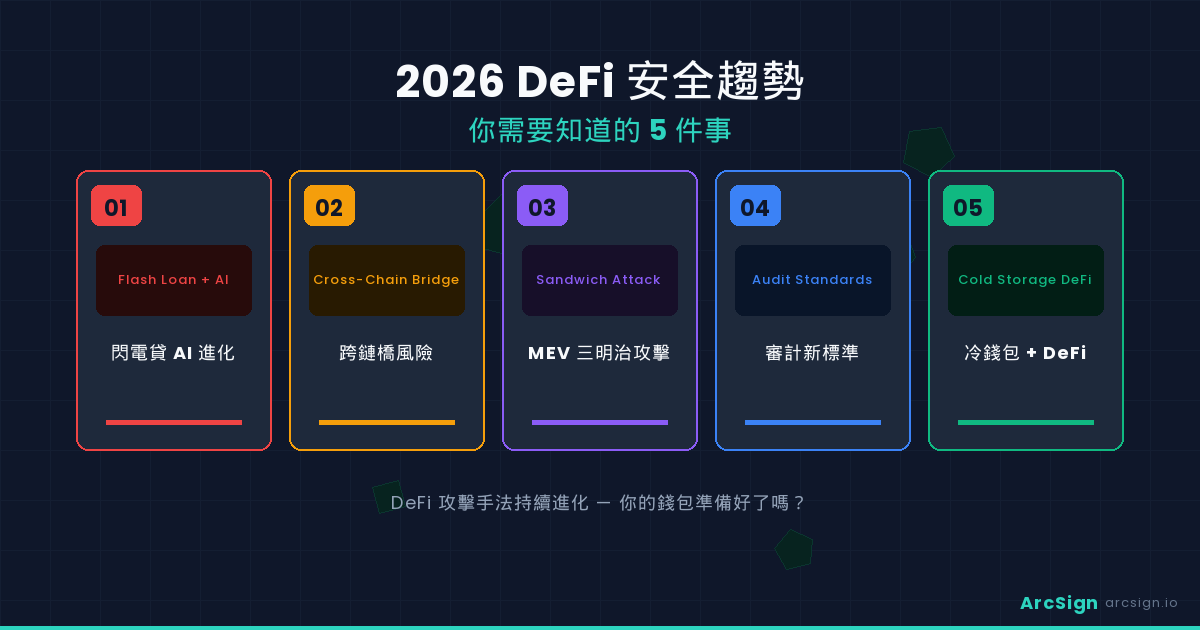
- DeFi Security Today: Hard Lessons from 2025
- Trend 1: AI-Powered Flash Loan Attacks
- Trend 2: Cross-Chain Bridges Remain the Largest Attack Surface
- Trend 3: The Silent Drain of MEV Sandwich Attacks
- Trend 4: Smart Contract Auditing's New Standards
- Trend 5: Cold Wallet + DeFi — A New Security Paradigm
- Self-Protection Guide: 5 Steps to Secure Your DeFi Assets
- Encrypted Backup: The DeFi User's Last Line of Defense
- FAQ
DeFi Security Today: Hard Lessons from 2025
Decentralized finance (DeFi) has seen explosive growth over the past few years, but the security incidents that came with it have been equally staggering. Throughout 2025, DeFi security losses hit new records, with data from DeFiLlama and Chainalysis putting the total in the billions.
As we enter 2026, the DeFi ecosystem continues to expand, with Total Value Locked (TVL) reaching new all-time highs. But security threats are evolving in parallel — attacks are becoming more sophisticated, more automated, and wider in scope. Understanding these trends isn't optional anymore; it's essential for protecting your assets.
The average recovery rate for DeFi exploits is less than 20%. That means for every $1 million stolen, less than $200,000 is typically recovered. Prevention is always better than recovery.
1AI-Powered Flash Loan Attacks
Flash loans are a uniquely DeFi invention — they allow users to borrow large amounts within a single transaction, as long as the loan is repaid before the transaction ends. The mechanism itself is neutral, but it dramatically lowers the capital barrier for attackers.
The key shift in 2026: AI-driven vulnerability scanners have become standard tools in the attacker's arsenal. These tools automatically analyze newly deployed smart contracts on-chain, identify price oracle manipulation opportunities, reentrancy bugs, and logic flaws, then automatically construct exploit transactions.
The Evolution of Flash Loan Attacks
| Era | Attack Characteristics | Notable Cases | Loss Scale |
|---|---|---|---|
| 2020–2022 | Manual vulnerability discovery, single-protocol attacks | bZx, Harvest Finance | Millions |
| 2023–2024 | Cross-protocol combo attacks, oracle manipulation | Euler Finance, Mango Markets | Tens of millions |
| 2025–2026 | AI auto-scanning + cross-chain combo attacks | Multiple undisclosed events | Hundreds of millions |
Flash loan attacks primarily target protocols, not individual wallets. However, if you have deposits or liquidity in a compromised protocol, your assets may be affected. Choosing well-audited protocols and diversifying your DeFi positions are key risk-reduction strategies.
2Cross-Chain Bridges Remain the Largest Attack Surface
Cross-chain bridges connect different blockchains, enabling assets to flow freely between Ethereum, BSC, Polygon, and other networks. But because bridges lock up massive amounts of funds, they've become hackers' favorite targets.
Looking back, some of the largest crypto security incidents in history targeted bridges: Ronin Bridge ($625M), Wormhole ($320M), and Nomad Bridge ($190M). This trend continues into 2026.
Why Are Bridges Especially Dangerous?
- Concentrated funds: Bridge smart contracts lock up massive amounts, making them high-value targets
- Large attack surface: Security must be maintained across multiple chains simultaneously — a vulnerability on any chain can be exploited
- Complex validation: Cross-chain message verification relies on validators or relayers that can be compromised
- Upgrade risks: Contract upgrades may introduce new vulnerabilities, especially with multisig-controlled upgrade mechanisms
Positive Developments in 2026
The good news is that cross-chain security technology is advancing too. In 2026, we're seeing several positive developments: zero-knowledge proof (ZK) bridges are maturing, replacing trust assumptions with mathematical proofs; optimistic verification mechanisms now include longer challenge periods and more monitoring nodes; and cross-chain communication standards like Chainlink CCIP are gaining wider adoption.
When using ArcSign's cross-chain features, your transactions are signed via USB cold wallet — your private keys never leave the device. Even if a bridge's frontend is replaced by a phishing attack, attackers cannot obtain your private keys without your confirmation. ArcSign supports BTC, ETH, BSC, Polygon, Arbitrum, and Optimism.
3The Silent Drain of MEV Sandwich Attacks
MEV (Maximal Extractable Value) is a problem unique to blockchains. In simple terms, miners or block builders can manipulate transaction ordering within a block to extract profit. The most impactful form for regular users is the sandwich attack.
How Does a Sandwich Attack Work?
Imagine you want to swap 10,000 USDC for ETH on Uniswap. Your transaction is sent to the mempool where everyone can see it. A sandwich attacker will:
- Front-run: Buy ETH before your transaction, pushing the price up
- Your trade executes: You buy ETH at the now-higher price
- Back-run: The attacker sells ETH at the price you pushed it to, pocketing the difference
You end up receiving less ETH than you should, and the difference is the attacker's profit. This all happens in seconds, and most users never even notice.
According to Flashbots data, over $1 million in MEV is extracted on Ethereum daily. A significant portion comes from sandwich attacks. If you trade on DEXs, you've almost certainly been "sandwiched" — you just might not have realized it.
MEV Protection Progress in 2026
- Private transaction pools: Services like Flashbots Protect and MEV Blocker keep your transactions out of the public mempool
- Order Flow Auctions (OFA): Route MEV revenue back to users instead of being captured by attackers
- DEX aggregator optimization: Smart routing reduces the price impact of individual trades, shrinking the attack window
- ArcSign integration: ArcSign's built-in DEX Swap integrates OpenOcean + KyberSwap aggregators, automatically routing to optimal trade paths to minimize slippage and MEV impact
4Smart Contract Auditing's New Standards
Smart contract auditing has always been a cornerstone of DeFi security, but 2026 is bringing major shifts in what "audited" really means. In the past, a single report from a reputable audit firm was enough to inspire confidence. Today, the community and investors demand much more.
Three Major Upgrades in Audit Standards
Top DeFi protocols now undergo at least 2–3 independent audits from different firms. Each firm brings different expertise and methodologies, and multiple audits catch issues that any single review might miss. Trail of Bits, OpenZeppelin, Certora, and Spearbit each have distinct strengths.
Formal verification uses mathematical proofs to confirm that contract behavior matches its specification — going beyond human code review. In 2026, more protocols are adding formal verification alongside traditional audits, particularly for high-stakes core logic like lending rate calculations and liquidation mechanisms.
Traditional audits are "snapshot" reviews — once completed, subsequent contract changes fall outside the audit's scope. The 2026 trend is deploying on-chain monitoring systems (like Forta and Hypernative) that detect anomalous transaction patterns in real-time and can automatically pause contracts before an exploit causes widespread damage.
| Audit Level | Coverage | Best For | Trust Level |
|---|---|---|---|
| Basic | Single-firm audit report | Small DeFi protocols | Medium |
| Advanced | Multi-audit + Bug Bounty | Mid-to-large protocols | Medium-High |
| Top-tier | Multi-audit + Formal verification + Continuous monitoring | Blue-chip DeFi protocols | High |
5Cold Wallet + DeFi — A New Security Paradigm
In the past, using DeFi essentially meant using a hot wallet like MetaMask. You needed an always-online wallet to sign transactions and interact with DApps. But this also meant your private keys were constantly exposed in a network-connected environment — if your computer was compromised, your keys could be stolen.
A major trend in 2026: more DeFi users are adopting cold wallets to sign on-chain transactions. This has been enabled by the maturation of protocols like WalletConnect v2 and cold wallets like ArcSign that deeply support DeFi operations.
Cold Wallet DeFi Security Advantages
| Feature | Hot Wallet (MetaMask) | Cold Wallet (ArcSign) |
|---|---|---|
| Private key location | Browser memory (persistent) | USB offline storage |
| Key exposure during signing | Entire browser session | Only 1–5 milliseconds |
| Malware risk | High (browser extensions can access) | Extremely low (USB isolation) |
| Phishing protection | Relies on user awareness | Keys never in the browser |
| Token approval management | Manual checking required | Built-in management + batch revoke |
| Memory protection | No mlock | mlock + XOR sharding |
| DEX Swap | Requires connecting to external DEX | Built-in aggregator |
| Cost | Free | Free |
ArcSign lets you connect to virtually any DApp via WalletConnect while keeping your private keys protected on a USB cold wallet. You can also perform DEX swaps directly within ArcSign without leaving the secure environment. Combined with built-in token approval management, you can review and revoke smart contract permissions at any time — preventing forgotten approvals from becoming attack vectors.
Self-Protection Guide: 5 Steps to Secure Your DeFi Assets
Now that you understand the 2026 security landscape, here are five concrete steps every DeFi user should take:
Regardless of which DeFi protocol you use, sign your transactions with a cold wallet. ArcSign supports WalletConnect for free, letting you securely connect to Uniswap, Aave, Compound, and other major DApps.
Every time you interact with a DeFi contract, you typically grant it permission to spend your tokens. Old, unused approvals can become attack vectors. ArcSign supports token approval management across 6 EVM chains, and Pro users get batch revoke capability.
Before depositing any funds, confirm the protocol has at least one audit from a reputable firm — ideally multiple audits. Check whether it has a bug bounty program and real-time monitoring system.
Don't put all your funds in a single protocol. Even the most established DeFi protocols can be exploited. Spread your capital across multiple protocols and chains to limit the maximum damage from any single incident.
DeFi involves frequent transactions, and you need to be able to recover quickly if something goes wrong. Use ArcSign's .arcsign encrypted backup (AES-256 encryption) — export to a second USB with one click to ensure you can always restore your wallet.
Encrypted Backup: The DeFi User's Last Line of Defense
When you're actively participating in DeFi, your wallet likely holds multiple tokens across multiple chains with various contract interaction records. If your USB is damaged or lost, you need fast, secure recovery.
Traditional paper seed phrase backups have serious security flaws:
- Paper is fragile: Vulnerable to water, fire, fading, and pets
- Zero encryption: Anyone who sees it can steal all your assets
- Prone to errors: One wrong letter when writing by hand could mean permanent loss
- More copies = more risk: Each additional copy is another exposure point
ArcSign offers a better solution: one-click export of an AES-256 encrypted .arcsign backup file. The file is automatically encrypted upon export — there's no separate step to set a password. Even if the backup falls into someone else's hands, it's completely uncrackable without the password.
| Backup Method | Paper Seed Phrase | .arcsign Encrypted Backup |
|---|---|---|
| Encryption | None (plaintext) | AES-256 encrypted |
| If found by others | Instant theft | Uncrackable |
| Backup speed | Manual writing, 5–10 minutes | One-click, seconds |
| Recovery speed | Manual word-by-word entry, error-prone | One-click import + password |
| Multiple copies | Each copy is plaintext exposure | Each copy is encrypted |
If you're an active DeFi user, export an .arcsign encrypted backup to a separate USB at least once a week. This way, even if your primary USB fails, you can restore all wallets and settings in minutes. The backup file is unreadable without your password, even if someone else gets their hands on it.
Frequently Asked Questions
What is the biggest DeFi security threat in 2026?
The biggest DeFi security threats in 2026 are cross-chain bridge exploits and the evolution of flash loan attacks. Bridges are prime targets due to the massive funds they lock, while flash loan attacks have become more dangerous with AI-automated vulnerability scanning and cross-chain attack composition.
Can a cold wallet prevent DeFi attacks?
A cold wallet cannot prevent smart contract-level attacks like flash loan exploits, but it effectively prevents asset loss from private key theft. Using ArcSign to sign DeFi transactions ensures that even if your computer is compromised, attackers cannot access your private keys. Additionally, ArcSign's token approval management helps you revoke dangerous contract permissions.
What is a MEV sandwich attack and how do I prevent it?
A MEV sandwich attack occurs when an attacker places transactions before and after your DEX trade to exploit your slippage for profit. Prevention methods include: using lower slippage tolerance, using private transaction channels like Flashbots Protect, and choosing DEX aggregators with MEV protection. ArcSign's integrated OpenOcean aggregator automatically routes to optimal trade paths to minimize MEV impact.
How can I check if a DeFi protocol is safe?
Check for audit reports from reputable firms, review TVL and operating history, verify if the team has public identities, confirm contracts are open-source and verified, and look for bug bounty programs. Using ArcSign's token approval management to regularly review and revoke unnecessary contract approvals is also important.
Is DeFi insurance worth it?
DeFi insurance has matured in 2026 but still has limitations. Protocols like Nexus Mutual and InsurAce cover smart contract vulnerabilities but typically don't cover flash loan attacks or price manipulation. If you have significant funds in DeFi, insurance can be part of your risk management strategy, but it should not replace fundamental security practices like using a cold wallet and limiting token approvals.
Protect Your DeFi Assets with a Cold Wallet
ArcSign Pro offers batch token approval revocation, best-route DEX swaps (auto-compares multiple aggregators), and multi-chain NFT management. USB offline signing + AES-256 encrypted backup — DeFi with peace of mind.
Download ArcSign Free → Upgrade to Pro